Most of the rules in the Highway Code are written to leave a margin of error, so that there is a clear 'no-mans-land' between potentially conflicting parties. If a collision occurs in this 'buffer zone', it is because both parties are at fault. If one party makes a momentary mistake, the 'buffer zone' protects both parties.
I remember reading about someone ( probably one of James Thurber's aunts or maids ? ) who just knew that it was always perfectly safe for her to blast across junctions at full speed, because everyone else had been taught to proceed with caution, and give way if necessary.
Showing posts with label sharing. Show all posts
Showing posts with label sharing. Show all posts
Monday, 16 November 2015
"The Other Idiot ..."
No comments:
Labels:
asl,
awareness,
crossing,
highway code,
intimidation,
law,
police,
rights,
sharing,
yt


Monday, 26 October 2015
Daytime Running Lights - No Guarantee
This case is interesting for many reasons: pedestrians, cyclist and motorist could all do better to manage risk, but the motorist is clearly breaking the law.
- Media bias
- Victim-blaming
- Everyone is in too much of a hurry - taking silly risks
- Road position - cycle lane or mid-lane ?
- Green light but give way !
- Low sun
- Flashing headlamp while sun is still shining
- Strava
No comments:
Labels:
awareness,
bikeability,
crime,
headlights,
nlp,
pedestrian,
primary position,
priority,
rights,
risk,
rlj,
sharing,
speed,
victim-blame,
whorf,
wobr,
yt
Monday, 9 March 2015
Cycle-proofing
The use of the word "Cycle-proofing" to imply "considering cyclists when designing roads" alarms me.
There are two similies that spring to mind:
There are two similies that spring to mind:
- 'fool-proof' implying cyclists are fools - perhaps they need not aspire to the lofty heights of intelligence and competence that we see displayed by 'professional drivers' on a daily basis, but considering that children are often cyclists might be beneficial.
- 'water-proofing' - impermeability - cyclists cannot pass through here ?
See also
- How smart language helped end Seattle’s paralyzing bikelash - [ PeopleForBikes ]
Friday, 3 October 2014
Dazzled by Headlights or the Sun ? Stop !
There have been many recent cases where drivers that drive while blinded by low sun have been acquitted of dangerous or even careless driving. Judges are ignoring the Highway Code when sentencing, and instructing juries to ignore it when deliberating the verdict.
If nothing else, this is unnecessary tautological duplication.
Fog is already an accepted excuse for bad driving, so I wonder which universally-encountered weather conditions will be blamed for bad driving next ? Ice, Snow, Rain, Wind, Night, Cloud ?
The principle used to be Highway Code 126
Really, I would advise not using the roads when the sun is low. Extreme but safe !
Even slowing down is dangerous.
RAF Northolt Station Commander killed on A40 - [ Road Justice ]

If nothing else, this is unnecessary tautological duplication.
93 Slow down, and if necessary stop, if you are dazzled by bright sunlight.It seems that we have no protection when on east-west roads after dawn or before dusk under UK case law. Perhaps there should be a curfew ?
6. Hot weather ...
237 ... If you are dazzled by bright sunlight, slow down and if necessary, stop.
Fog is already an accepted excuse for bad driving, so I wonder which universally-encountered weather conditions will be blamed for bad driving next ? Ice, Snow, Rain, Wind, Night, Cloud ?
The principle used to be Highway Code 126
Drive at a speed that will allow you to stop well within the distance you can see to be clear.Pro Tip : If a car's number plate appears to be lit up, you are directly between them and the sun, so you are invisible.
Really, I would advise not using the roads when the sun is low. Extreme but safe !
Even slowing down is dangerous.
RAF Northolt Station Commander killed on A40 - [ Road Justice ]
"He was dazzled by sunlight, he slowed down and moved to the slow lane when other drivers were flashing their lights to say has driving too slowly, and that he was looking out for motorcyclists overtaking him at the time of the crash. He drove into the back of Group Captain Tom Barrett OBE, who was cycling"
1 comment:
Labels:
awareness,
coast,
crime,
democracy,
headlights,
impunity,
intimidation,
justice,
keith peat,
light,
motorism,
parking,
pedestrian,
risk,
sharing,
space,
speed,
terrorism,
tooslow,
victim-blame
Tuesday, 23 September 2014
There's more to life than not being dead ...
In safety statistics, analysts often use KSI (Killed or Seriously Injured) statistics.
Main reasons :
Main reasons :
- Numbers killed often are, thankfully, too low for any statistically-significant conclusions to be drawn until many years have passed.
- Serious Injuries are usually about ten times more frequent, and often life-changing. So taking measures to reduce them is arguably just as important as reducing fatalities.
- Many other factors affect whether a casualty dies :
- Vehicle engineering - crumple zones, airbags, seat-belts, safety glass
- Emergency service response, particularly Air Ambulances
- Medical care in hospital
Further than that, there are many 'Quality of Life' issues that are worth considering.
- Perceived Safety
- Improved lifestyle
- Community well-being
- Stress and Mental Health
Monday, 22 September 2014
Weaving all over the road ...

When I was a Sea Scout (1973-7 Hi to the 1st Scrabster troop!), Dick Message aka 'Skip' taught us how to tell if two vessels were on collision course. There are two equivalent methods:
- With a compass take a bearing on the other vessel, wait a minute and take another.
If the bearing hasn't changed, you are on collision course. Change course. Repeat.
Obviously, if both vessels change course and are still on a different collision course, slowing down can help, too ! - If there is land on the distant horizon, (or stars above it) see if the other vessel is moving fore or aft relative to the distant land or stars. If neither, ie the vessel is stationary with respect to a distant landscape, you are on collision course. Of course, it won't hold true for a nearby coastline, or if you watch for hours because the stars 'move' (relatively speaking).
"All our eyes on the distant horizon" Join in, everybody !
What does that have to do with cyclists 'weaving all over the road', you ask ? Patience !
Monday, 8 September 2014
Counter-CounterMeasures - Glasses, Goggles, Face-Mask
Things are moving too fast for me here - I have started several 'Countermeasures' posts-in-draft, but it feels more important to post about Counter-CounterMeasures first !
If motorists have reached the stage of squirting liquids in cyclists' faces, then that is another good reason to consider wearing Glasses, Goggles or Face-Mask.
If motorists have reached the stage of squirting liquids in cyclists' faces, then that is another good reason to consider wearing Glasses, Goggles or Face-Mask.
No comments:
Labels:
abreast,
bloodycyclists,
court,
cps,
education,
hatred,
headlights,
intimidation,
motorism,
overtaking,
police,
road rage,
sharing,
space,
wobr,
yt
Thursday, 28 August 2014
Obedience and Blame
The number of official contributory factors present in car-bike collisions are similar for cyclists and drivers.
Some factors are arguably bigger than others - I don't know if they were weighted.
The full report runs to 60 pages.
Slightly more contributory factors for cyclists, but I would guess it's not statistically significant.
Since the motorist is (almost?) never the fatality, that may introduce some bias. It would be interesting to exclude cases where the cyclist was unable to give a statement before dying.
Of course, risking your own life is not at all the same thing as risking anothers' !
The top factor was 'failed to look properly' for both sides, in about 30% of cases.
Monday, 25 August 2014
Traffic Calming - Pedestrian Refuges

You would think a council would re-think dangerous features, instead of erecting 9-word signs.
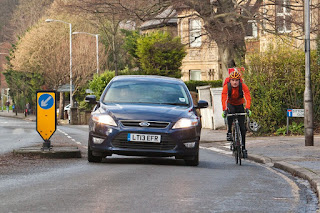

Pedestrian refuges are certainly an aggravating factor when motorists want to overtake cyclists.
I would be interested to know if they are actually useful to pedestrians, and whether they have a positive or negative effect on overall safety. I suspect that their only effect is to bring traffic speeds down, but at the cost of cyclists' safety.
No comments:
Labels:
bloodycyclists,
education,
hatred,
highway code,
intimidation,
mgif,
motorism,
overtaking,
primary position,
priority,
punishment pass,
road rage,
sharing,
space,
speed,
terrorism,
tooslow,
wobr,
yt
Sunday, 24 August 2014
The Highway Code in 100 words

The Highway Code in 100 words was an exercise in reducing the bloat and distilling the essential spirit of the Highway Code, when it was last published in 2007.
It came from a pro-speed, anti-camera motoring campaign group's forum, but is none the less interesting for that !
Saturday, 23 August 2014
Two Tribes Go To War (people, vehicles, modes)
Some people ask "Why can't we all just get along?"
This is the thinking behind 'Shared Spaces' and 'Share the Road'.
(not to be confused with 'shared space' - roads are shared space by default : exceptions include motorways and 'mandatory cycle lanes').
They generally object to the distinction between cyclists and motorists - "Sometimes I cycle, sometimes I drive, so the distinction is artificial - I am both".
If this approach really worked, there would be no problem.
There is a problem, so maybe it doesn't work ?
Am I missing something ?
No comments:
Labels:
awareness,
bloodycyclists,
education,
humour,
intimidation,
ll,
road rage,
sharing,
wobr,
yt
Thursday, 31 July 2014
No aggro but ... respect the road the way I do ... because I've got registration (OV13 VNM)
There's a motorcyclist who seems to like to educate London cyclists about mobile phone use by very direct means - a mirror to the elbow.
Tuesday, 29 July 2014
Tragedy of the Commons
According to Wikipedia, The tragedy of the commons is an economics theory by Garrett Hardin, according to which individuals behave contrary to the whole group's long-term best interests by depleting some common resource.
The original example was common grazing land - all the commoners could buy more cattle to graze there, so they all did, resulting in over-grazing resulting in the cattle dying.
I think it now applies to roadspace - anyone can own a car, so too many do. People are reluctant to drive somewhere, if they fear it will be difficult to find a parking space there. Motorists even object to those that use less space, fearing they move more slowly.
Subscribe to:
Posts (Atom)